
 By Sarah Xiao
A humanoid robot differs from an industrial arm in one structural respect that governs every material decision: it carries its own body. A fixed arm’s mass is paid for once, in the base. A humanoid pays for its mass on every step, every turn, every time it stands up — and the joint has to accelerate that mass before the workpiece ever moves.
That is why the material conversation in robotics is not really about density. It is about where the density sits, and what stiffness you are willing to trade for it.
Weight is positional, not global
Removing a kilogram from the forearm buys more than removing a kilogram from the torso, because the arm’s distal mass multiplies through the joint’s moment of inertia. The same holds for the shank and foot: lighter distal segments mean faster swing, lower energy per step and easier balance control. A useful rule when reviewing a design: ask for the mass breakdown by link, not the total. Two robots at 60 kg can behave very differently.
But lighter is not automatically better. Joint mounts, bearing seats and reducer interfaces need stiffness and dimensional stability. If the structure deflects under load, a lighter part produces positioning error, vibration and shortened reducer life — the weight saving is spent on precision and maintenance. The engineering problem is the joint optimum of mass, stiffness, strength, fatigue life and manufacturable cost, and it has no single answer.
Aluminium is still the default, for process reasons
For frames, joint housings and brackets, aluminium wins on something other than specific strength: process optionality. It machines well for prototype batches, casts well once the design freezes, has a mature and deep supplier base, and tolerates design churn. 6061 and 7075 cover most structural needs at different strength and cost points.
For a company still iterating its design weekly, “easy to make, easy to change, easy to deliver” beats “lightest” almost every time. This is the same logic that decides most sourcing questions in this industry, and it is why aluminium’s share will not collapse just because lighter options exist.
Magnesium is finding its opening
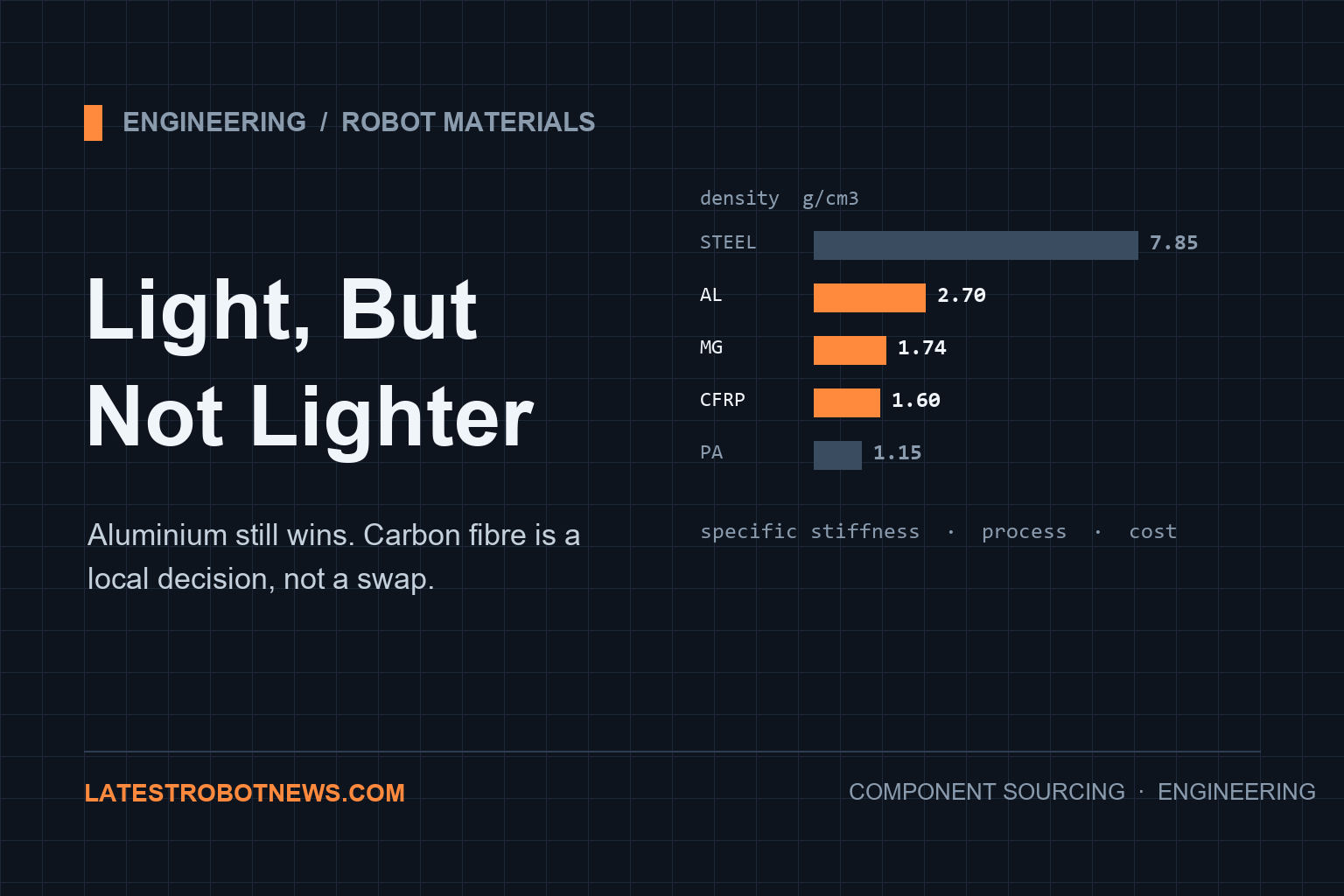
Magnesium is roughly 36% less dense than aluminium (1.74 versus 2.70 g/cm³), which is real mass on a housing or a bracket. Reporting from August 2026 put semi-solid magnesium forming into exploration for embodied-AI components — the appeal is not only the material but the process, since thixotropic forming can cut part count and downstream machining by producing near-net shapes.
Four problems have to be solved before it scales: corrosion protection, surface treatment, forming yield, and joining — particularly the galvanic couple when magnesium is fastened to aluminium or steel. Any supplier quoting magnesium without a stated coating system and a dissimilar-metal isolation plan is quoting a demo, not a part.
Steel is not going away
Shafts, pins, gears and high-contact-stress joints stay steel. At equal volume steel costs less and hardens better; for gears and load-bearing pins, lightweighting must yield to fatigue life. The correct architecture is not one material but a division of labour: aluminium where geometry and cost dominate, steel where contact stress and life do, magnesium where a housing can absorb the process risk.
Carbon fibre: correct in a narrow band
CFRP offers high specific stiffness and strength, and it is genuinely the right answer for long, slender links and some covers where mass at the end of a lever matters.
It is the wrong answer in three common situations. When the design is not frozen — every ply schedule change is a new tooling and qualification cycle. When the part is handled, bumped or repeatedly assembled — composite damage is often subsurface and invisible. And when the connection details dominate: bolt holes, threaded inserts and local load introductions need metallic inserts and reinforcement, which quietly removes much of the saving.
The realistic path is local substitution: start with an arm link or a non-critical cover, instrument it, and expand only if the field data supports it.
Plastics and the outer skin
Engineering plastics carry the parts metals should not: housings, cable retainers, insulators, sliding components, guards. PA suits structural and wear parts; POM suits dimensional stability with low friction; PEEK handles heat and chemistry but costs enough that it needs a named requirement to justify itself. Injection moulding’s real advantage is integration — ribs, clips and cable channels in one shot, fewer assembly steps.
The outer layer deserves more respect than it gets. On a service robot that touches people, it has to deliver feel, abrasion resistance, tear strength and cleanability over years. Joint covers must flex thousands of times without either restricting motion or splitting. Tesla’s Optimus job listings have named exactly this cluster — outer materials, foam, fabric, abrasion, long-term durability, human-contact safety — which is the clearest signal that skin is engineering, not styling.
| Material | Density g/cm³ | Where it wins | Where it fails |
|---|---|---|---|
| Steel | 7.85 | gears, pins, high contact stress | anything mass-sensitive |
| Aluminium | 2.70 | frames, housings, design churn | maximum weight saving |
| Magnesium | 1.74 | housings, part-count reduction | corrosion, joining, yield |
| CFRP | 1.60 | long links, stiffness-critical | redesign churn, impact, inserts |
| PA / POM / PEEK | 1.15–1.45 | housings, wear parts, integration | structural load paths |
Six questions to put in the RFQ
Most material failures in sourcing are specification failures, not material failures. Ask these before comparing price:
- Exact grade and temper. “6061” is not a specification; 6061-T6 and 6061-T651 have different properties and different stress histories.
- Forming process, named. CNC, die casting, thixotropic forming, injection — the process determines both tolerance and the volume at which the price breaks.
- Batch consistency data. Not a certificate of conformance, but dimensional Cpk and mechanical test results across at least three lots.
- Coating and corrosion system. Especially magnesium and any dissimilar-metal joint; ask for the isolation method, not the coating name.
- Allowable stress and fatigue basis. The load case behind the safety factor — static only, or 10⁶ cycles at the stated stress ratio.
- Traceability to heat or lot. For structural and safety-relevant parts, this is what makes a recall survivable.
What this means for suppliers
The opportunity has three layers, and they reward different capabilities.
Raw material requires scale and formulation capability, but robot volume is still small enough that it is a marginal line for most material producers; the question is whether robot demand can ever be more than a rounding error for them.
Processing is where most of the near-term work is: precision machining, die casting, injection, composite layup, surface treatment, inspection. The realistic entry is not “core supplier to a humanoid OEM” but one bracket or one small batch, expanded as the design freezes.
Co-design is the durable position but the hardest to sell: joining the customer’s design cycle early enough to change a material, merge two parts, or delete an assembly step. It is consulting work that turns into a supply contract — and it is the only layer that survives a price-down cycle.
Robot designs are still moving, and no material has won. Betting on a material is a weak strategy; owning a part and the process behind it is a stronger one. The competition looks like it is about materials, but it is decided by whether material, structure and process can be made to agree — at a cost the market will pay.
Related reading
- Robotics shutdowns 2026: funding is not delivery capability — why the machining-to-die-casting switch has already killed one humanoid maker.
- Robots building robots: one a day, then one an hour — how production cadence forces the material and process decisions above.
- Robot component sourcing: from prototype to production — qualifying a supplier once the design freezes.
Sources: material densities and property comparisons are standard reference values; the semi-solid magnesium forming development and the Tesla Optimus outer-material scope follow the reporting of 机器人世家 (16 October 2026) and public job listings. The RFQ checklist, the positional-mass argument and the three-layer supplier framing are Latest Robot News editorial.