
 By Sarah Xiao

On 23 October 2026, business daily Meijing reported that Nanjing-based Wujing Dynamics (无境动力) owed roughly ¥8 million in wages to thirty to forty staff and had stopped work. Four months earlier the company had closed ¥110 million in financing and announced nearly ¥500 million of framework orders with state-owned enterprises, plus another ¥500 million described as reserve orders.
Eight months, from local-government showcase to labour arbitration. We took that company’s arithmetic apart separately. What matters here is that it is not an outlier.
In the first half of 2026, China’s embodied-AI sector raised roughly ¥93.5 billion across nearly 300 rounds — close to ¥600 million a day. On the same timeline, a group of robot companies ran out of runway before first delivery. Most of them had raised a new round or carried a marquee backer within the previous twelve months.
| Company | Segment | Public timing | Outcome |
|---|---|---|---|
| Longhui Medical | Orthopaedic surgical robots | January | Bankruptcy liquidation |
| Cartwheel Robotics | Home humanoid robots | February | Ceased operations |
| Suzhou Xinsong Industry | Industrial robots | February | Bankruptcy / shutdown |
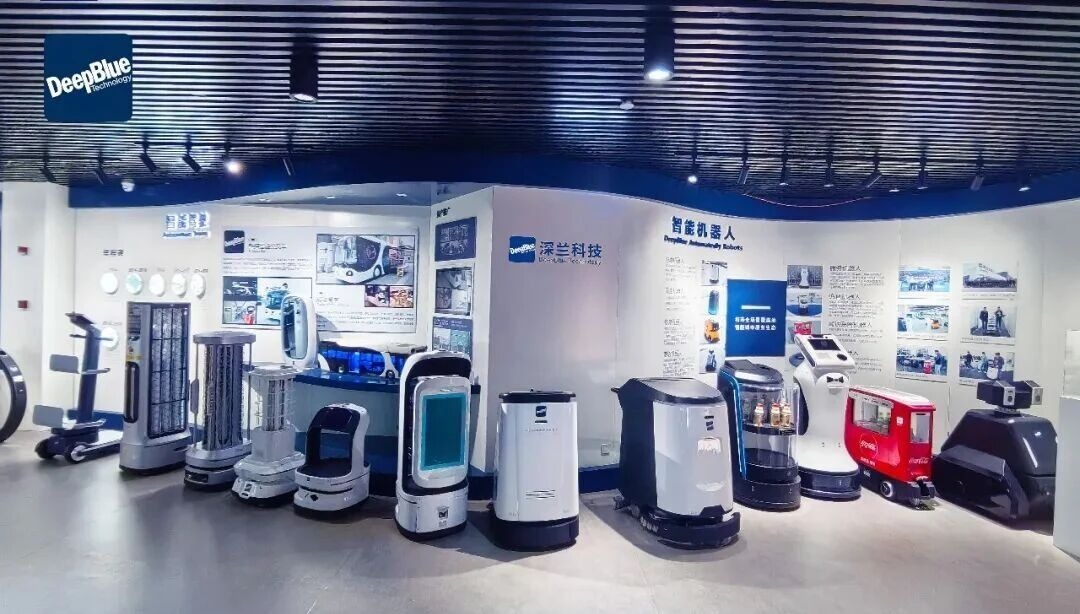
| DeepBlue Robotics | Commercial cleaning, delivery, disinfection | From May | Liquidation accepted; claims from 102 staff exceed ¥23 million |
| Vicarious Surgical | Abdominal surgical robots | July | Wound down, liquidation |
| Yinghe Robotics | Emergency response, city management, warehousing, medical, industrial | August | Bankruptcy; 2025 revenue ¥4.33 million |
| Zhicheng Dynamics | Pool-cleaning robots | September | Bankruptcy review |
| Digital Jiying | Robot R&D and sales | September | Shut down |
| Wujing Dynamics | Industrial quadrupeds | Wages unpaid from August | Work stopped; ~¥8 million owed |
Note: not an exhaustive list; compiled from court notices and public reporting. “Bankruptcy / shutdown” covers judicial liquidation, voluntary wind-down, bankruptcy review and asset disposal. Figures are as reported; we have not independently verified the amounts.
The ratio that explains the year
The cheapest way to judge whether a sector is overheated is to divide the money by the goods.
Global humanoid shipments in the first half of 2026 were about 19,100 units, up 272 percent year on year, with Chinese manufacturers taking more than ninety percent. Spread ¥93.5 billion across 19,100 units and you get roughly ¥4.9 million per robot shipped.
That number is not a unit cost. The numerator covers the whole embodied-AI chain — components, data, chips — while the denominator counts only finished humanoids. But it does establish one thing: the speed at which money arrives and the speed at which machines leave the building are not in the same order of magnitude.
Four ways to die, one place to land
Read the public record of all nine and there are four causes. They converge on one point: the money ran out before the company could fund itself.
One: exhibit thinking. DeepBlue’s trajectory is the clearest. A court accepted its liquidation in May 2026, with claims from 102 employees exceeding ¥23 million. Wage arrears had appeared as early as 2023, and the company did not comply with orders to correct them. It ran cleaning, delivery and disinfection lines simultaneously; demonstrations were polished, deployment stalled at acceptance. One reported ¥700 million disinfection order shrank to a fraction of its headline after pandemic demand receded. The financial base: group revenue of ¥120 million in 2022 against a net loss of ¥92.17 million. The money became capacity and prototypes, not cash flow.
Two: scope beyond validation. Yinghe Robotics was reported at a $500 million peak valuation, with business lines spanning emergency management, city governance, warehousing and logistics, healthcare and industrial manufacturing, plus an announced hundred-billion-yuan industrial base. In 2025 it booked ¥4.33 million of revenue and a ¥67 million net loss. Its Ji’an subsidiary reported zero employees on social insurance in the 2024 filing. An investor publicly described core executives paid more than ¥3 million after tax while the company had no stable operating cash flow, ¥28 million spent on office renovation, and a ¥90 million order accepted on a 47-day delivery window that ended in default and a damages claim.
Using the size of a round to set the size of the organisation is the most expensive of the four failure modes.
Three: the supply-chain gap. The clearest overseas case is K-Scale Labs, which wound down in November 2025. Its open-source K-Bot carried an early pre-order price of $8,999 against a prototype cost above $100,000. Moving from machined parts to die casting meant redesign, tooling, certification and inventory; the founder put the requirement at $25 million against $6.25 million raised, with about $400,000 left in the account. More than a hundred pre-orders and over $2 million in deposits were refunded in full.
The most useful line in the post-mortem: because the company negotiated separately with several contract manufacturers instead of building supplier relationships, unit cost for the same robot swung between $800 and $2,400. As the founder put it, the supply-chain gap cannot be filled with sentiment and open source.
Four: prototype skills without engineering skills. Two surgical-robot companies died in the same year, and they point at something different: the barrier in that category is not the demo, it is registration, clinical evidence, quality systems and service. A prototype can enter an operating theatre; a product has to enter a hospital procurement catalogue, and between those two lies years of organisational work.
The investment test changed; many teams did not
Before 2026, the three most effective items in a fundraising narrative were a star team, a famous university and a good demo. The questions now are: do you have real customer contracts? What is the repeat-purchase rate? What is the field failure rate? Does the unit economics close?
This is not investors becoming smarter. The denominator changed. When a sector absorbs more than ¥90 billion in a year and ships fewer than 20,000 units, anyone can tell the story of “the next ten thousand.” Once the leaders start publishing quarterly gross margin, the story stops working.
CAICT expects the first clearance cycle to complete through competition over the next two to three years. Xinding Capital expects that of nearly a thousand humanoid companies in China, ten to twenty may remain. If either is right, the 2026 list is the first batch, not the whole of it.
Who survives
Three plain rules.
First, finish one point before claiming generality. Factory handling, industrial inspection, commercial delivery: the arithmetic closes, the acceptance criteria are explicit, the customer is a business. Taking one point to repeat purchase is harder than demoing five directions, and worth more.
Second, let product validation set the cash rhythm, not the round size. Headcount, number of lines, size of the plant — these should follow “the last batch passed acceptance,” not “the last round closed.” Yinghe’s mistake was not the choice of verticals; it was an organisation that grew ahead of validation.
Third, treat the supply chain as a core competency, not a procurement task. K-Scale’s lesson is concrete: when unit cost swings by a factor of three depending on which factory you call, you do not have a cost model, and without a cost model you do not have pricing power.
You do not need a launch event to judge a robot company. Three numbers: units delivered, months in continuous service, repeat-purchase rate. All three and it is a business; one and it is a project; none and it is a narrative.
2026 is being called the year of mass production. The more accurate label is the year of validation — not of whether the technology moves, but of whether the business can turn over on its own.