
 By Sarah Xiao
Astribot (星尘智能) closed a RMB 1 billion round on 13 October at a post-money valuation of RMB 15 billion — its fourth round in six months, and a 50% valuation increase in three months. The company is four years old and has one distinguishing feature: it does not use rigid joints.
That choice is the story, and it is not primarily a story about AI. It is a story about what a robot’s bill of materials looks like when the actuator moves away from the joint.
What cable drive actually changes
In a conventional humanoid, each joint is a stack: frameless torque motor, harmonic reducer, encoder, torque sensor, bearing housing. The motor must sit at the joint because the reduction stage is where the torque is made. That puts mass exactly where it hurts most — at the distal end of the limb, multiplying through inertia, and it forces every joint to carry its own reducer.
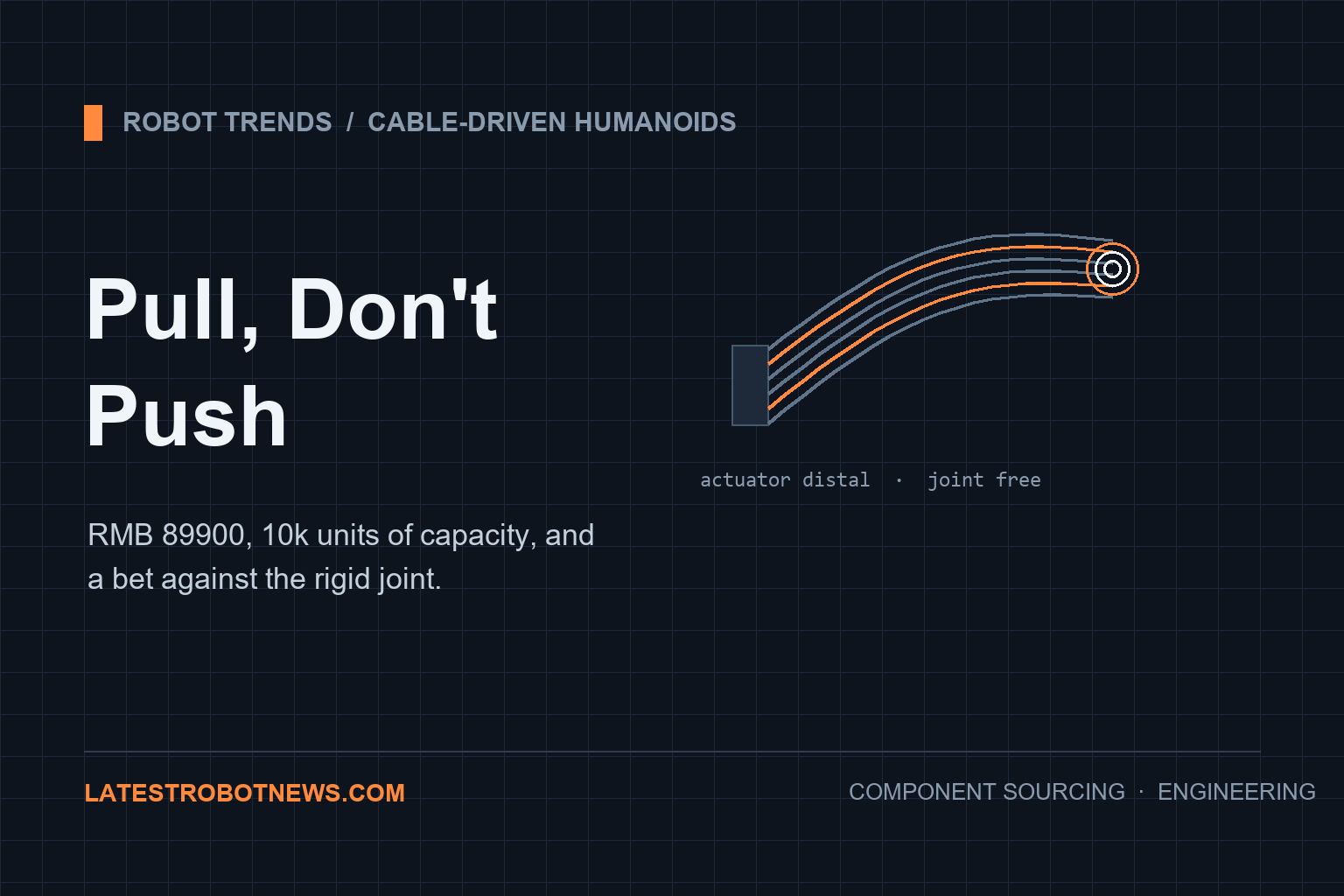
Cable drive (绳驱) puts the motor proximally, in the forearm or the torso, and transmits force through tendons running over pulleys — the same arrangement as a human hand, where the muscles that move your fingers sit in your forearm.
Three consequences follow, and only one of them is usually discussed.
Mass moves inward. Distal inertia drops sharply, which is why the T1 can be priced at RMB 89,900 and still perform fine manipulation. The company’s argument, made by founder Lai Jie since his Tencent Robotics X days, is that removing the reduction stage makes force nearly transparent to the control model — the robot can “feel while doing” instead of inferring contact from current.
The reducer leaves the joint. This is the part the supply chain should be reading. A humanoid with 40 joints has, on the rigid architecture, something like 40 harmonic reducers. A cable-driven hand may need none in the fingers at all, because the tendon itself provides the compliance and the transmission. For a component maker whose business is precision reducers, cable drive at scale is a demand-side risk, not a technical curiosity.
The force sensor’s job is partly taken. If the tendon’s own tension can be measured, the joint gets continuous force feedback without a dedicated six-axis sensor at every articulation. Not eliminated — a wrist still wants one — but the count per robot falls.
The BOM, side by side
| Joint content | Rigid joint | Cable-driven joint |
|---|---|---|
| Actuation | Frameless torque motor at the joint | Motor proximal, in forearm or torso |
| Reduction | Harmonic or planetary reducer, one per joint | None at the joint; tendon ratio and pulley geometry instead |
| Transmission | Rigid, integrated | Tendon over idlers, with a tensioner |
| Force sensing | Torque or six-axis sensor per joint | Tendon tension measurement, plus one wrist sensor |
| New failure modes | Reducer wear, backlash | Creep, wear, strand failure, tension drift |
| New critical parts | Reducer, crossed-roller bearing | Tendon material, pulley, tensioner, routing |
Read the bottom two rows. Cable drive does not remove engineering difficulty; it relocates it. The parts that become scarce are not reducers but tendons — and the engineering that matters is tension management, not gear grinding.
Where the difficulty actually is
The company is candid about the three problems: creep, deformation and wear. A polymer tendon under sustained load lengthens over time, which silently changes the relationship between motor angle and joint angle. Wear changes friction. Both degrade calibration, and both are cumulative in a way that a geared joint’s backlash is not.
The mitigations claimed are software-hardware coupling, in-house compensation algorithms, and in-house materials and tooling. That is plausible — and it is also exactly the kind of claim that only survives contact with a thousand deployed units. The honest measure is not the demo; it is the maintenance interval and the tension-recalibration cost after twelve months in a retail store.
Which is why the commercial numbers matter more than the valuation. The T1 ships from June 2026 at RMB 89,900. The company claims ten-thousand-unit capacity across the S and T lines, thousand-unit orders with Jinma Amusement, Xingong Intelligence and ThunderSoft, deployments in retail, culture, logistics and research, and Robot MART retail stores in six cities since November 2025. Research orders are reportedly sold out with capacity booked a month ahead.
If those numbers hold through a year of operation, cable drive stops being a minority thesis and starts being a sourcing reality.
What a buyer should ask
- Tendon material and its creep specification. Not “high-strength fibre” — the grade, the manufacturer, and the measured elongation under rated load at 1,000 hours.
- Tensioning method and recalibration interval. Whether tension is set once at assembly or compensated in service, and what the customer has to do about it.
- Wear life in cycles, and the replacement procedure. Which tendon, how many cycles, how long the swap takes, and whether it needs a trained technician.
- Single-tendon failure behaviour. A tendon failure is a compliance collapse, not a joint lock. Ask what the robot does — and whether it is safe doing it.
- Force accuracy over life, not at t=0. Tension-based force sensing drifts with the tendon. Ask for the accuracy curve at 0, 6 and 12 months.
The strategic read for suppliers
Three positions, ranked by how quickly they are affected.
Reducer makers: the exposure is real but slow. Cable drive removes reducers from fingers first, then wrists; the shoulder and hip are likely to stay geared for a long time because the torque density is hard to replace. Watch the joint count per robot, not the announcement count.
Tendon and tensioner suppliers: the window is open now. Fibre, termination, idler and tensioner design are all still custom, which is the definition of an early supply chain. The company that standardises a tendon module with a published creep curve wins a category.
Force-sensing suppliers: the story is mixed. Fewer joints need a six-axis sensor, but the ones that remain need better ones, and tension sensing needs calibration hardware. The count falls while the specification rises — which favours suppliers who can sell accuracy rather than volume.
The structural point is worth repeating: a technology shift in actuation is a procurement shift before it is a capability shift. The 150 billion valuation is a bet that cable drive works. The sourcing question is what you do about it while the bet is still open.
Related reading
- CIIF 2026 signal: force-controlled arms beat biped demos — the other side of the same argument, from the joint side.
- Robots building robots: one a day, one an hour — why volume, not valuation, decides which architecture survives.
- Humanoid robot market H1 2026: 36,000 units, top five all Chinese — the demand base this architecture is competing for.
Sources: funding, product, capacity and order details from 经济观察报, 科创板日报 and 澎湃新闻 reports of 13–14 October 2026; the technical framing of cable drive follows Astribot’s published material and 机器人宝典 (15 October 2026). The BOM comparison, the failure-mode questions and the supplier exposure analysis are Latest Robot News editorial.