
 By Sarah Xiao
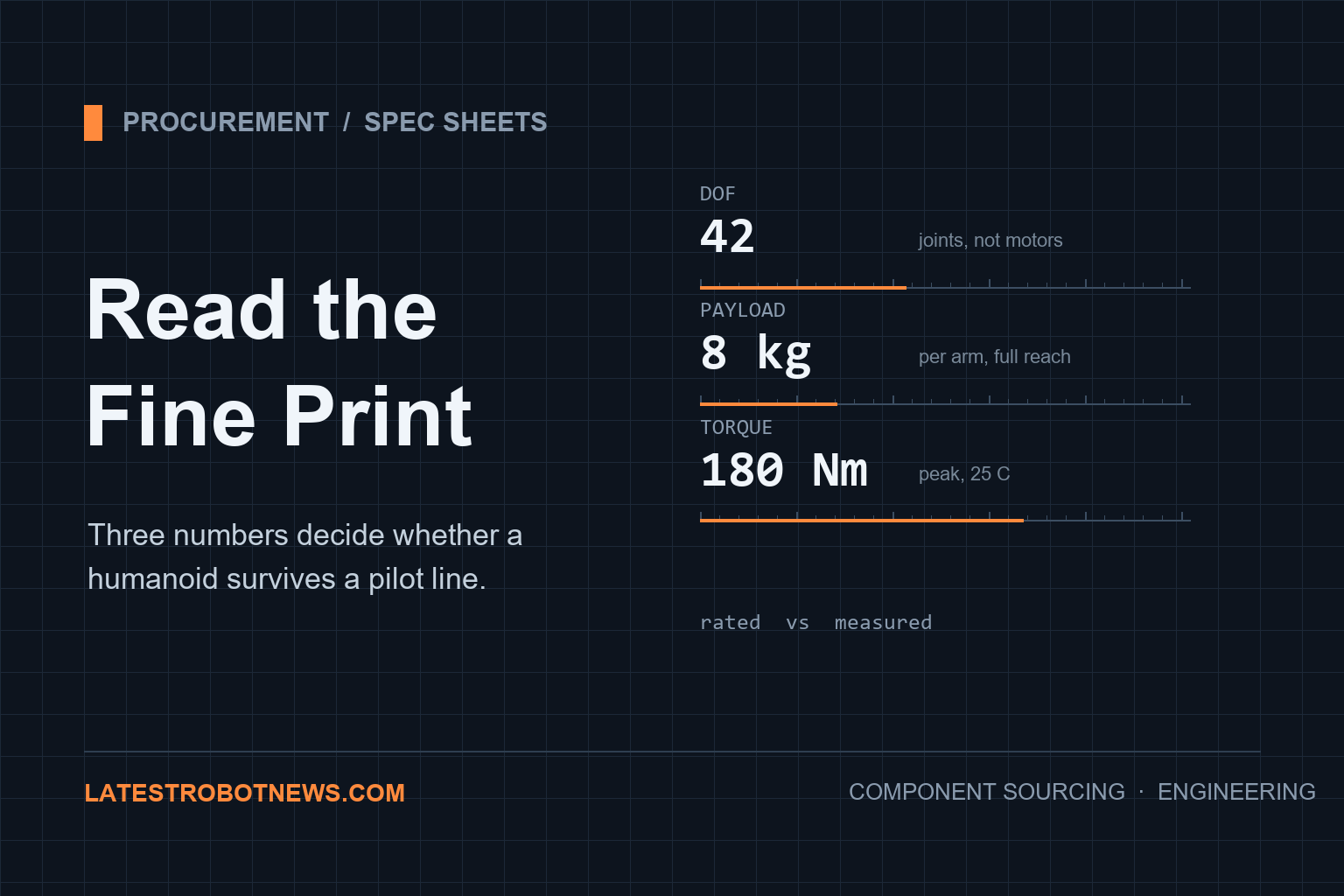
Vendor spec sheets for humanoid robots look comparable, but the numbers behind them are rarely measured the same way. Three figures decide whether a platform survives a pilot line.
Degrees of freedom. Count joints, not motors. A wrist with two degrees of freedom can still be driven by three motors through differential gearing. Ask how many degrees of freedom sit in the hand alone — dexterous hands often account for a third of the total.
Payload. Rated payload is usually quoted per arm, at full extension, with the battery at nominal charge. Ask whether the figure still holds at 80 percent extension, which is where most real manipulation happens.
Torque density. For harmonic drives and quasi-direct-drive actuators, request continuous output torque together with the gear ratio. Peak torque alone says little about duty cycle or thermal margin.
Ask for the test conditions in writing. Suppliers who can provide them are usually the ones whose numbers still hold after a thousand cycles.
Related reading
- Humanoid robot market H1 2026: 36,000 units, top five all Chinese — the market scale these spec sheets are being sold into.
- CIIF 2026 signal: force-controlled arms beat biped demos — what vendors chose to show when the show mattered.
- Robot component sourcing: from prototype to production — qualifying a supplier once the numbers check out.