
 By Sarah Xiao

Three motor topologies dominate the humanoid joint conversation: frameless torque motors, coreless motors, and axial-flux motors. The industry keeps asking which one wins. That question is malformed. Each of the three occupies a different point in the trade-off space between torque density, response speed, and manufacturing maturity — and a humanoid has between 20 and 40 joints that do not want the same thing.
The useful question is narrower: for a given joint, on a given bill of materials, at a given production volume, which motor can you actually buy, integrate and cool?
Answering that requires doing the arithmetic first.
Three bills every joint asks you to pay
A humanoid joint is not an industrial servo axis. An industrial arm carries a fixed load at a steady cycle; a humanoid walks, climbs, jumps, and picks things up, so its joints see frequent starts, stops and impact loads. Peak torque is routinely several times the continuous figure, which is why joint motor vendors design for three times overload and above — Zhihui (昊志机电) publishes a 3.5× figure.
All of that has to fit inside a torso weighing 30 to 40 kg at human scale. Unitree’s G1 is about 35 kg in total. The volume left for a single joint is measured in millimetres.
Low speed, high torque, small envelope, fast response, low power draw. Those five requirements contradict each other, which is exactly why no single motor type wins everywhere.
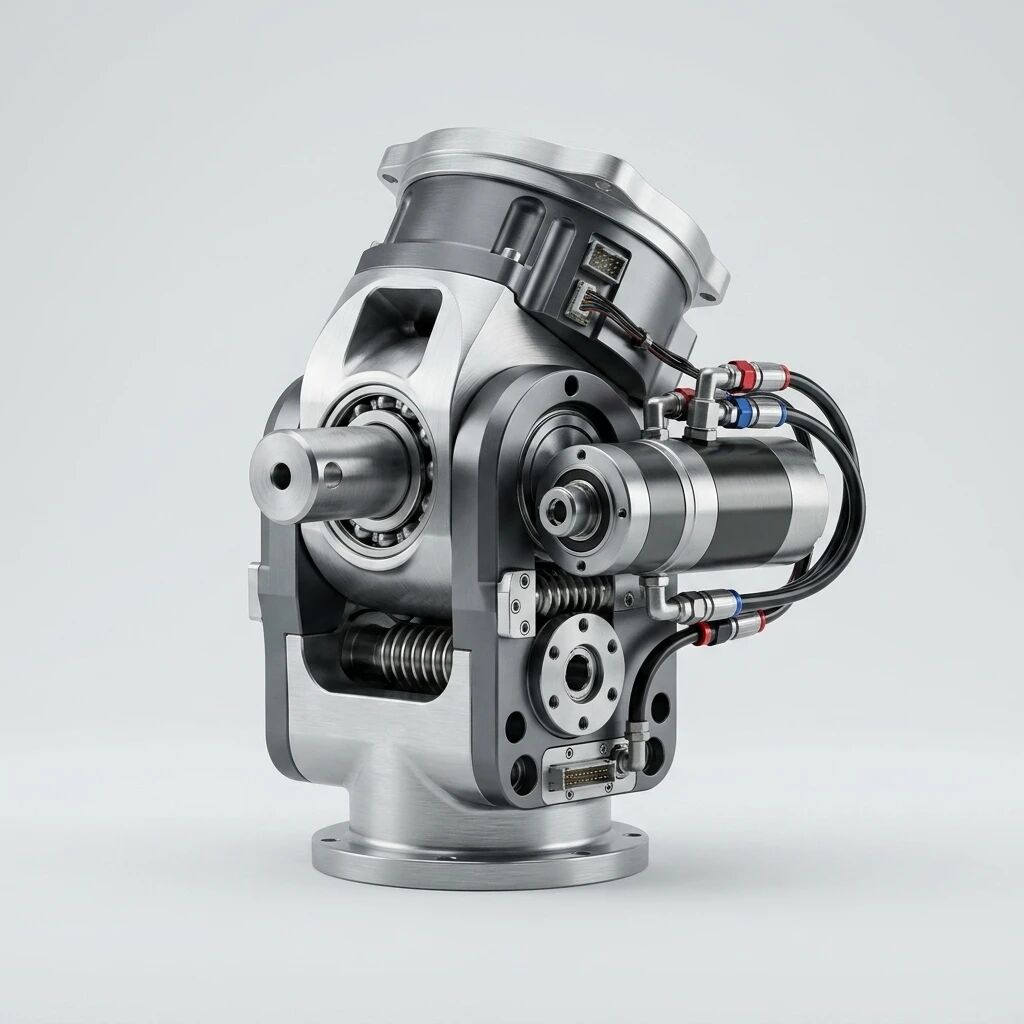
The torque bill. A motor on its own almost never produces enough torque at the joint, so a reducer multiplies it: output torque equals motor torque times ratio times efficiency. A larger ratio buys torque, but rotor inertia is reflected to the output multiplied by the ratio squared, and that is what destroys force transparency. It is the reason force-controlled joints deliberately keep the ratio moderate instead of chasing the largest number available.
The response bill. The electromechanical time constant is rotor inertia times winding resistance, divided by the product of the torque constant and the back-EMF constant. Those two constants are numerically equal in SI units, so the whole expression reduces to how much inertia you are asking the current to accelerate. Coreless motors win here because their rotor inertia is an order of magnitude smaller, dropping the time constant into the low milliseconds — Faulhaber quotes 5 to 11 ms on several series.
The thermal bill. A humanoid joint is a sealed can. There is no cabinet, no fan, no open frame. Continuous output power is limited by winding temperature rise, not by electromagnetic design. On a lot of joints the bottleneck is the heat path from stator to housing, and that problem reappears in every section below.
Frameless torque motors: the production default
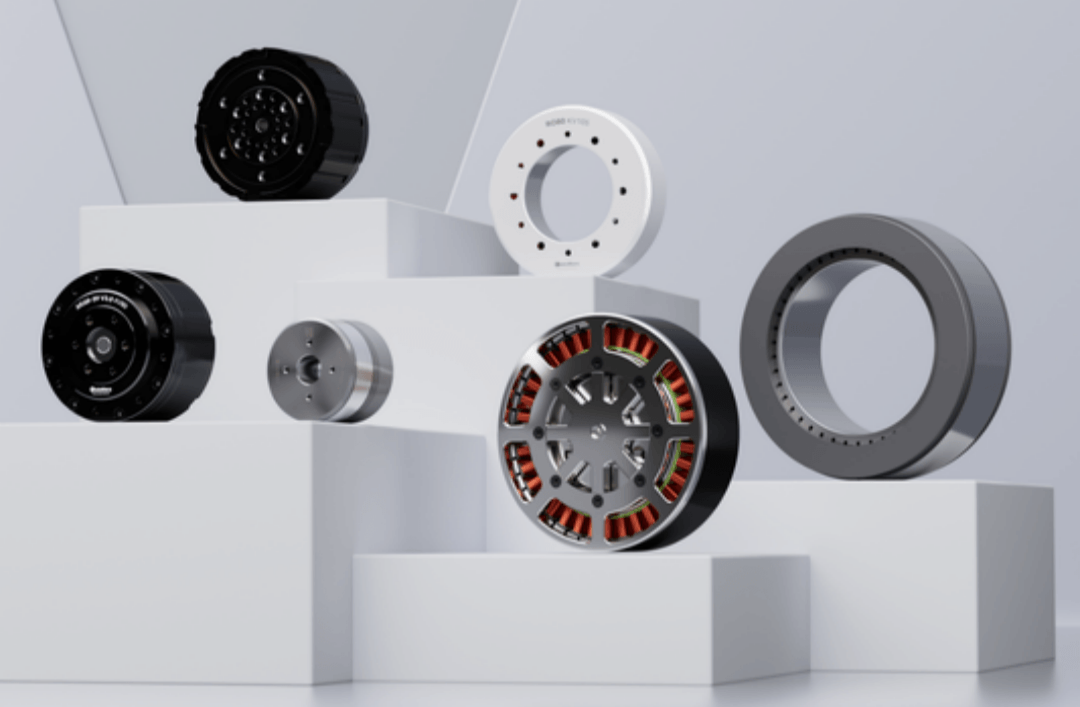
A frameless motor strips away the housing, the bearings, the end caps and the output shaft. What arrives is a stator — copper winding on laminated steel — and a rotor carrying the permanent magnets. The actuator builder presses them into the joint housing.
That looks like a step backwards in productisation and is the opposite in practice. The housing you saved is replaced by the joint structure that had to exist anyway, axial length drops, and a hollow rotor lets the harness pass straight through the middle. The joint gets thinner and cleaner.
Tesla’s Optimus is the clearest public case. All 28 actuators in the published teardown accounts use frameless motors as the power source: 14 rotary actuators built as frameless motor plus harmonic reducer, 14 linear actuators built as frameless motor plus planetary roller screw.
Unitree’s numbers show the same architecture at a different price point. The G1’s in-house joint motor is a low-inertia, high-speed inner-rotor PMSM with a maximum torque of 120 N·m, hollow shaft, dual encoders and crossed roller bearings; the knee peaks at 90 N·m and 120 N·m in the EDU version. The previous H1 generation reached 360 N·m peak per joint with a published peak torque density of 189 N·m/kg.
One detail from the G1 teardown is worth pausing on: the lower-leg module is a four-in-one of motor, two-stage planetary reducer, encoder and driver — not a harmonic unit. On that joint, impact resistance and cost beat precision. Reducer selection is part of motor selection, not a separate decision made afterwards.
On the supply side, the overseas reference points are Kollmorgen, TQ-RoboDrive and Aerotech — long histories, heavy industrial and aerospace install bases. Kollmorgen’s TBM2G covers seven frame sizes from 50 to 115 mm with continuous stall torque from 0.27 to 6.03 N·m. Chinese vendors have moved from sampling to volume: Buke (步科) has shipped over 100,000 frameless units across 50 to 160 mm frames and 0.11 to 9.2 N·m, with its newer FMK hollow series extending to eight frames from 25 to 115 mm; Leisai’s FM2 series claims 10% more torque and 20% lower loss at equal current, backed by a planned 300,000-unit annual capacity and reported intent orders above 100,000; Zhihui quotes torque ripple at or below 1%.
The market is not enormous, which shapes behaviour. Global frameless torque motor revenue was about 657 million USD in 2023 and is projected at 903 million by 2030.
Trade press now cites headline torque density above 45 N·m/kg, with some vendors claiming over 70. Treat those numbers carefully. Torque density has at least four definitions in circulation — peak versus continuous, and motor alone versus complete actuator. When comparing, ask for continuous stall torque and the winding temperature rise it is rated at, not the peak figure on the brochure.
Coreless: the dexterous hand’s de facto standard
A coreless motor removes the iron core from the rotor or stator, winding the conductor into a cup that sits directly in the magnetic gap. No iron means no cogging torque, no iron loss, and rotor inertia roughly an order of magnitude lower. Efficiency in the small and medium power range reaches about 90%.
For a finger joint that must open and close thousands of times an hour inside a few tens of millimetres, and must never feel notchy, that combination is close to ideal.
The price is real. Without iron to carry flux, utilisation is poor and standalone torque is tiny — a domestic 8 mm unit delivers roughly 1.8 mN·m of continuous torque. It only drives a finger through a high-ratio multistage planetary, a worm, or a tendon. And the winding is simultaneously the heat source and the only structural member, so long-term overload deforms it. Temperature rise and life are hard limits, not margins.
Optimus’s hand is publicly described as 6 actuators driving 12 coreless motors. Unitree’s optional Dex3-1 three-finger hand takes the same route: micro motor plus transmission. Brokerage teardowns estimate the dexterous hand at roughly 17% of humanoid BOM, with the drive units as the largest block.
At the high end Maxon and Faulhaber still set the reference. Moons’ (鸣志) covers 13 to 30 mm across its coreless range, with reported efficiency of 92% and a cost around one eighth of imported top-tier product; Dingzhi (鼎智) has its 8 mm brushed and 10 mm brushless coreless units in sampling with leading humanoid programmes.
The variable worth tracking: Optimus’s next-generation hand relocates the motors into the forearm and drives the fingers by tendon, and some analyses expect a share of the coreless positions to be taken by small slotted brushless motors. Coreless is not about to be displaced in the hand, but the “only answer” label is loosening.
Axial flux: the perennial next generation
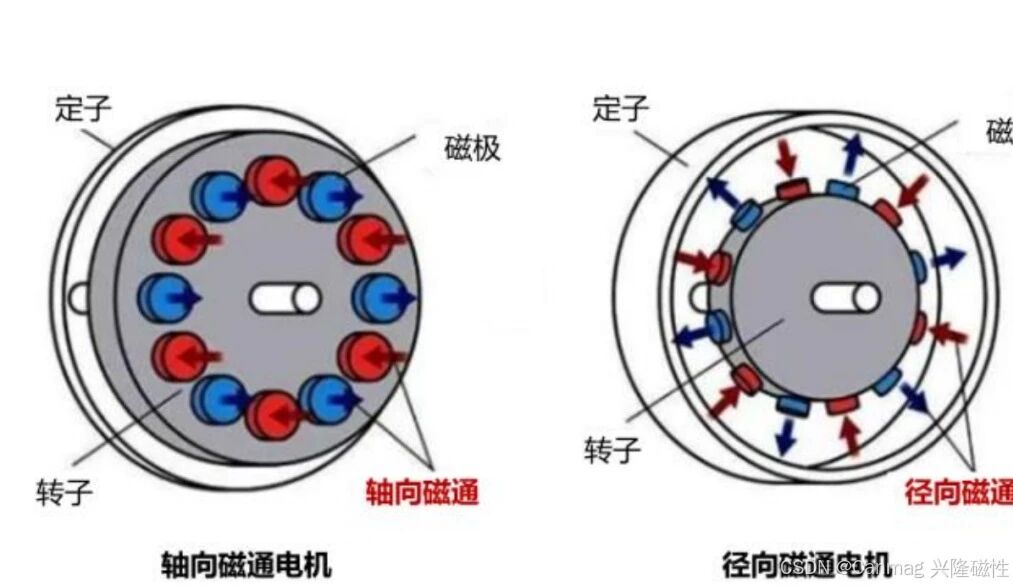
An axial-flux motor turns the air gap ninety degrees. Stator and rotor face each other as two discs, and torque is generated at a larger effective radius. For the same volume the torque density is materially higher than a radial machine, and the axial length is short, which suits flat joint envelopes.
Work published by a domestic research institute in June 2026 reports an axial-flux machine using new high-performance magnets at roughly 50% less mass and 50% shorter axial length for equivalent performance. Industry reports cite power density several times that of conventional radial designs. After validation in new-energy vehicles and low-altitude aircraft, robotics is the next target, and at least one domestic vendor has publicly cited joint prototypes above 200 N·m/kg.
Four engineering hurdles stand between that and a shipping joint.
Tolerance chain. An axial gap means the rotor floats between stator faces. Housing face runout, bearing clearance and assembly preload all eat directly into gap accuracy. Batch consistency is hard.
Bearings and magnetic pull. Disc rotors generate axial magnetic force. The bearing carries both the preload and the rotor’s own weight, and its life design is more demanding than in a radial layout.
Stator manufacturing. Wound ring laminations or soft magnetic composites still have immature stamping, winding and potting processes. Capacity and yield trail the radial lamination route.
Cost and heat. Double-stator and multi-disc architectures use more material, and the heat path inside a sealed joint has not changed.
The industrial progress is genuine: domestic axial-flux products have accumulated over 50,000 units shipped in new-energy commercial vehicles, agricultural machinery and small marine applications, and in 2026 at least one company announced volume production for robot applications with orders booked into 2028. But going from “there is a product” to “the default choice for a humanoid’s main joints” still requires full validation of cost, supply chain and batch consistency. The fair reading today: axial flux belongs at axially constrained, torque-hungry joint locations and in direct-drive experiments. It is a route to track, not the current answer.
Selection by joint class
| Joint | Motor | Transmission | Reasoning |
|---|---|---|---|
| Hip, knee, shoulder, elbow | Frameless torque | Harmonic or planetary | Best balance of density, supply chain and cost; the production consensus |
| Waist, wrist, ankle | Frameless, small frame (50 mm class) | Harmonic or cycloidal | Ankle is where axial-flux evaluation is concentrated |
| Fingers | Coreless | Multistage planetary, worm or tendon | Bought for millisecond response and zero cogging, not torque density |
| Linear joints | Frameless at high speed | Planetary roller screw | Rotary to linear thrust at high efficiency |
| Direct-drive experiments | Axial flux | None or 1:1 | Needs the gap tolerance and thermal path solved first |
Six traps worth avoiding
Pick the reducer first. Work backwards from joint output requirement to ratio, then select the motor so its operating point lands in the efficient region. Reverse the order and you will build a joint that runs hot and drains the battery.
Separate peak from continuous. Peak torque density depends on short-term overload. Inside a sealed joint, sustained output is set by the winding temperature rise at continuous stall torque. Thirty percent margin is the normal allowance, not a luxury.
Bring thermal design in early. The conduction interface between stator and housing, the potting process and the placement of temperature sensors decide whether the joint can hold continuous torque for hours. Plan them with the structure, not after the prototype overheats.
Judge force control by the feedback chain. Dual encoders — motor side plus output side — are now standard on mainstream humanoids, with torque estimated through the compliance of the reducer. Encoder resolution and mounting method should not be traded away for a better motor datasheet.
Coreless motors need a real driver. Low-inductance windings make the match between current-loop bandwidth and PWM frequency critical for both heat and acoustic noise. A cheap driver erases the physical advantage you paid for.
For axial flux, audit the tolerance stack first. Before debating electromagnetic numbers, check housing face runout and bearing arrangement. Beautiful figures on paper do not survive an assembly line that cannot hold a gap.
The short version
Frameless torque motors plus a harmonic or planetary reducer are the answer for the joints that carry the robot. Coreless motors own the fingers, and will keep owning them until tendon-driven forearms prove otherwise. Axial flux is the most interesting unproven option, and the one most likely to be over-claimed in a sales deck.
None of the three is a drop-in replacement for the others. The joint decides.